-
So What Are We Comparing?
-
Round 1: Safety Helmets—The $8 Hard Hat vs. a Vented Pyramex Safety Helmet
-
Round 2: Hi-Vis Apparel—The $12 Jacket vs. the Pyramex Hi Vis Jacket
-
Round 3: Safety Shoes—The $25 Boot That Cost Us More
-
Round 4: SRL Fall Protection—The One Place I Refuse to Go Cheap
-
Round 5: Chemical PPE—Answering "Which PPE Can Protect You from Liquid Chemicals?"
-
What I'd Tell Another Buyer
When I took over PPE purchasing in 2020, I figured my job was simple: find the lowest price on compliant gear, order it, done. It took one vendor who couldn't deliver on time and a near-miss on the plant floor to change my mind in a hurry. What I'm sharing here is the comparison I wish someone had shown me back then—cheap PPE vs. smart PPE—broken down by the categories I buy every year: safety helmets, hi-vis jackets, safety shoes, fall protection, and chemical-resistant gear.
For context, I'm an office administrator for a 300-person manufacturing company. I manage all safety supply ordering—roughly $80,000 annually across 10+ vendors. I report to both operations and finance, which means I feel the tension between budget targets and what the plant managers actually need.
So What Are We Comparing?
Price-focused buying means asking: "What's the cheapest helmet, jacket, or boot that meets the minimum standard?" Unit price wins the decision.
Value-focused buying means asking: "What's the total cost of this product over its useful life?" That includes replacement frequency, worker comfort, compliance risk, and injury risk.
I've bought both ways—and I have the spreadsheet scars to prove it. Here's how the two approaches stack up across five product categories.
Round 1: Safety Helmets—The $8 Hard Hat vs. a Vented Pyramex Safety Helmet
My first mistake was ordering 200 basic Type 1 hard hats because they were $5 cheaper per unit than a vented Pyramex safety helmet with Type 2 protection and a ratchet suspension. I saved $1,000 on that order alone. It ended up costing us more than $3,000 in the long run.
The cheap hats were genuinely uncomfortable. The pin-lock suspension pinched, and the sweatband absorbed nothing. By month four, I was replacing broken or "lost" units at a rate of about 20% per quarter. Meanwhile, the Pyramex helmets we'd tested in the office—with the cooling liner and vented shell—were the ones workers actually wanted to wear.
The comparison that changed my mind:
- Unit price: cheap hats win ($8 vs. $15-25 for a vented Pyramex safety helmet).
- Replacement rate: smart helmets win (quarterly replacement dropped from 20% to under 5%).
- Worker adoption: smart helmets win (a hat that stays on a head protects better than one left on a shelf).
- Protection level: smart helmets win (Type 2 covers side and lateral impacts—that matters on a busy floor with overhead cranes).
Here's what surprised me: after eight months, the "expensive" Pyramex helmet cost the same per worker per month as the cheap hat, because we stopped buying replacements. That's basically what total cost of ownership means. I wasn't the first person to figure this out, but I had to learn it the expensive way.
Round 2: Hi-Vis Apparel—The $12 Jacket vs. the Pyramex Hi Vis Jacket
Hi-vis was a category where I assumed "compliant is compliant." A vest with reflective striping is a vest with reflective striping, right? Not exactly.
I bought 50 cheap Class 2 hi-vis jackets in early 2022 at $12 each. They met ANSI/ISEA 107 for Class 2 garments on paper. Within three months, the reflective tape was peeling and the fabric had faded noticeably. On a night shift, that's not a minor issue—that's a worker becoming invisible.
The Pyramex hi vis jacket models I now stock run about $25-40 depending on the style. The reflective tape stays bonded, the fabric handles industrial laundering, and the jackets last 12-18 months in our environment. The cheap ones needed replacement every 3-4 months.
So the "expensive" jacket was actually cheaper per month of compliant wear. I get why buyers default to the lowest number—budgets are real. But the compliance risk, an OSHA citation or an accident where visibility was a factor, far outweighs the savings.
Round 3: Safety Shoes—The $25 Boot That Cost Us More
This is the category where I'm most embarrassed. In my first year, I ordered budget safety shoes for the warehouse team at about $25 a pair. They were ASTM-rated. They met the standard. They were also like walking on plywood, according to the crew.
Within two months, I had three complaints about foot pain and one worker who went to a clinic. That's when I started paying attention to what shoes actually do to people who stand on concrete for 10-hour shifts.
We switched to mid-range safety shoes in the $60-80 range. The difference was immediate: better cushioning, arch support, and toe protection that didn't dig into the foot. Foot-pain complaints stopped. I can't prove the switch directly reduced lost-time incidents—and I won't pretend otherwise—but the crew stopped buying their own insoles to fix a problem our $25 shoes created.
This round isn't just about price. It's about the value of asking workers what they think. The $25 shoes were cheap. The $70 shoes made the team feel respected. That has value even if it doesn't show up in the P&L.
Round 4: SRL Fall Protection—The One Place I Refuse to Go Cheap
If you've ever had to choose between a $120 SRL and a $300 SRL while the budget is already stretched, I feel you. But this is the category where "good enough" is the most dangerous phrase I can think of.
SRL stands for self-retracting lifeline. When a worker falls, the SRL locks and arrests the fall. The difference between models often comes down to braking distance, cable vs. webbing construction, service life, and inspection requirements. According to the National Safety Council, the average cost of a medically consulted workplace fall is roughly $50,000 in direct costs—before lost workdays, citations, and insurance premium increases. When a $180 price difference is the line between a solid system and questionable gear, the math is obvious.
Here's how I evaluate SRL fall protection now: braking distance (shorter is safer, and cheaper models often have longer braking distances), webbing vs. cable construction (webbing is lighter; cable handles sparks and heat better), inspection and recertification ease, and compatibility with the anchors and harnesses we already own.
The uncomfortable truth: I can't prove a more expensive SRL ever saved someone's life. Falls are rare in our facility. But the cost of being wrong in this category is too high to optimize for price. Trust me on this one.
Round 5: Chemical PPE—Answering "Which PPE Can Protect You from Liquid Chemicals?"
One of the most common questions I see from other buyers is: which PPE can protect you from liquid chemicals? The honest answer is: it depends on the chemical, the concentration, and the exposure route. And that's exactly why the cheapest option is never the right starting point.
The standard hierarchy for liquid chemical protection:
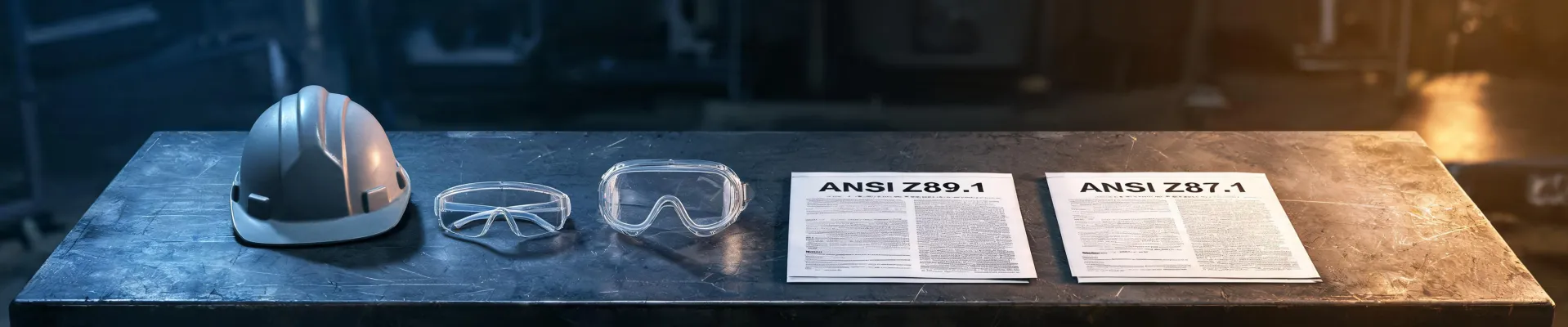
- Eyes and face: chemical splash goggles, not just ordinary safety glasses. A face shield for high-splash tasks. Pyramex safety glasses meet Z87.1 impact standards for general work, but for liquid chemicals you want a goggle that seals completely around the eyes.
- Hands: chemical-resistant gloves—but the material matters. Nitrile handles many solvents; neoprene handles acids and caustics; butyl is for specific chemicals. One "chemical-resistant" glove doesn't cover everything. Always check the manufacturer's chemical compatibility chart.
- Body: chemical-resistant aprons or full suits for large volumes. Regular fabric absorbs chemicals instead of repelling them.
- Feet: chemical-resistant boots when handling large volumes of corrosive liquids. Standard safety shoes aren't built for that.
The value angle is simple: buying properly rated chemical gloves at $3-5 per pair instead of general-purpose gloves at $1 means the worker handling solvents isn't getting chemical burns through their gear. One case of contact dermatitis will cost you more than a year of proper glove purchasing. To be fair, I used to think gloves were gloves. That changed when I read the chemical resistance chart and realized how specific it all is.
What I'd Tell Another Buyer
Here's where I admit my sample is limited. I've only worked in light manufacturing and warehouse environments. If you're in construction, food processing, or something more specialized, your priorities and standards may differ. My experience is based on roughly 200 PPE orders over five years.
Prices I've mentioned are as of Q4 2024. The safety market changes fast, so verify current pricing and standards before budgeting. Don't hold me to those numbers.
The principle, though, stays the same: don't ask "what's the cheapest compliant PPE?" Ask "what's the cost per month of actual protection?"
If you manage a stable crew, spec better-built gear. If you have high turnover, cheaper gear can make sense for occasional visitors. But for your core workers—the ones wearing this stuff every day—choose the better helmet, the right hi-vis jacket, proper footwear, and never skimp on fall protection or chemical gear.
And if you're just starting out? Ask your people what they think. I learned that lesson the expensive way, so you don't have to.

Maeve Callahan
Maeve Callahan is a head-protection analyst covering Type I and Type II hard hats, climbing-style safety helmets, bump caps, chin straps, suspensions, liners, and face-shield carriers. She applies ANSI Z89.1, EN 397, and EN 12492 criteria while comparing impact attenuation, penetration resistance, lateral deformation, electrical class, retention strength, field of vision, mass, fit range, and temperature conditioning. Her guides help EHS teams, contractors, utilities, and buyers select helmet systems for overhead hazards, work at height, electrical exposure, accessory compatibility, and worker acceptance.