-
Generic vs. Pyramex Hard Hat Liner Replacement: The $12 Mistake
-
Full Brim vs. Cap Style: What the Pyramex Ridgeline Taught Me
-
$30 Welding Hood vs. a Lincoln Electric Auto-Darkening Helmet
-
Vans Work Boots vs. Rated Safety Footwear
-
Can You Sleep With Earplugs?
-
What I'd Do Differently (and Where It's OK to Save)
I'll admit this upfront: I've spent seven years buying personal protective equipment for a crew of 60, and my first instinct has always been to find the cheapest option that “technically works.”
That instinct has cost me roughly $4,200 in wasted purchases, one badly bruised toe, and a decent amount of embarrassment.
Here are five PPE comparisons I got wrong—what I bought, what I should have bought, and why the choice matters more than the price tag.
Generic vs. Pyramex Hard Hat Liner Replacement: The $12 Mistake
The first mistake was assuming “universal fit” actually means something.
I needed replacement liners for our Pyramex hard hats. The OEM part ran about $12 more per hat and required a short wait. A generic liner at half the price promised universal fit. It said so right on the package.
It didn't fit. Not really. The foam was softer, the mounting clips never seated into the shell's slots, and the whole suspension wobbled. One of my crew showed me his liner had shifted almost completely out of position by the end of the day. That's not a comfort issue—it's a head injury waiting for an excuse.
The liner is the impact absorption system. If it doesn't lock into the shell properly, a hard hat becomes a plastic bowl with a sticker.
Now I buy OEM Pyramex liner replacements, including for our Ridgeline cap-style hats. The extra few dollars is the cheapest insurance I know.
Full Brim vs. Cap Style: What the Pyramex Ridgeline Taught Me
Here's a comparison where the conventional answer isn't always right.
For years, I bought full-brim hard hats because “more coverage equals more protection.” Then we switched to the Pyramex Ridgeline cap-style hard hat for utility work, and—surprise—the cap style actually ended up being safer for our team.
Why? Because PPE has to work together. The cap-style shell sits closer to the head, which means hearing protection muffs seal properly without a brim pushing them off. Welding and face shields sit closer to the face, reducing blind spots. And in tight spaces under machinery, there's no wide brim snagging on pipes.
Full-brim hats are genuinely better for outdoor work in sun and rain. I won't argue with that. But for mixed indoor/outdoor tasks, a cap style that's compatible with the rest of your PPE beats a full brim that fights your face shield. That's the kind of thing you learn when you watch a welder try to position his hood under a full brim.
The Ridgeline became our default for 70% of tasks based on compatibility, not because it looked nicer.
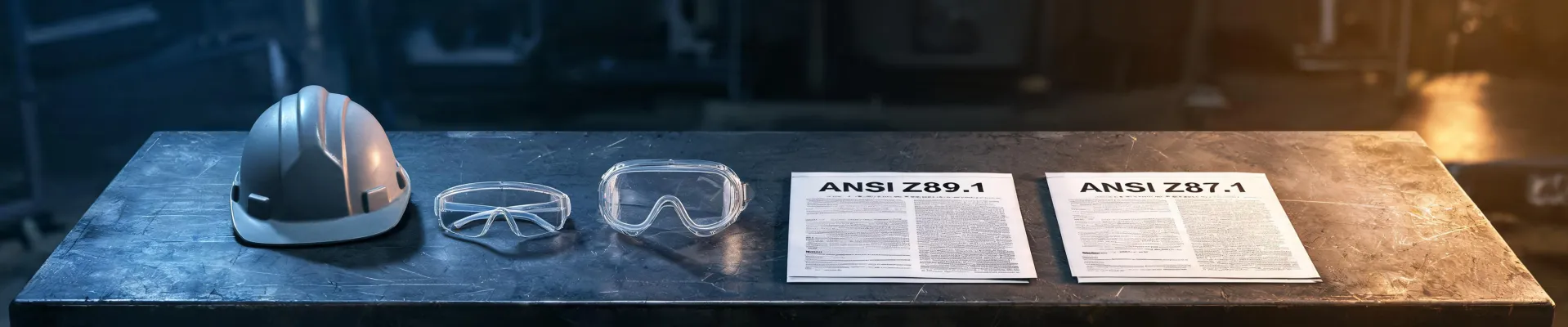
One more note: I'm not a safety engineer, so I don't pretend to get into the weeds of impact testing. What I do know is the ANSI/ISEA Z89.1 standard separates hard hats into Type 1 (top impact) and Type 2 (top and lateral impact). The Ridgeline cap-style model we use carries a Type 2 rating—but check your specific SKU before assuming.
$30 Welding Hood vs. a Lincoln Electric Auto-Darkening Helmet
In 2022, I bought five passive welding hoods for our fab bench. Thirty bucks each. They do the job—technically.
Here's what “doing the job” means: you flip the hood down, the lens stays dark, and you can't see your weld pool. To check anything, you flip it up. For occasional tack welding, that's fine. For real work, it's miserable.
It's also dangerous. I got flashed by a neighboring welder's arc while my hood was up. Even from several feet away, the light was intense, and my eyes burned for hours afterward.
That's when I borrowed a co-worker's auto-darkening Lincoln Electric welding helmet. The difference was immediate: the lens was clear when I positioned the gun, then went dark in milliseconds the moment the arc struck. No guessing, no flipping, no window where my eyes were exposed.
I'll be honest—the price hurt. I hesitated before ordering the first one. But after a month in real shop conditions, I ordered two more.
According to ANSI Z87.1, eye and face protection used in welding must meet specific optical and impact requirements. A passive hood can meet Z87.1. But it won't protect you from your own habit of flipping it up at the wrong moment.
Vans Work Boots vs. Rated Safety Footwear
September 2022. I needed boots. I found Vans work-style boots that looked right, fit great, and the product name literally included the word “work.” Good enough, right?
Wrong.
Those boots didn't carry an ASTM F2413 rating. The toe area was flexible fabric and rubber, not a reinforced cap. I found this out when a steel pipe fitting rolled off a scaffold and landed on my right foot. The boot compressed hard enough to crack the toenail bed. Three weeks of limping, a gross black-and-blue toe, and a supervisor who said: “Check the label on the tongue. The word 'work' doesn't count.”
Actually, let me be fair here. Vans isn't the bad guy—I bought the wrong product for the job. Some Vans styles do carry safety ratings, and their casual footwear is fine for what it's made for. The lesson is to check the ASTM marking on the boot itself, not just the product page, before assuming anything.
ASTM F2413-18 specifies performance requirements for footwear with impact-resistant toes and other protective features. It's not optional in most construction environments; it's the standard.
Can You Sleep With Earplugs?
This question comes up more than you'd think, especially from crew members who work rotating shifts and need to sleep during the day. So: can you sleep with earplugs?
Short answer: yes, occasionally. Longer answer: be careful.
Foam earplugs can reduce noise exposure by about 30 decibels when fitted correctly, but they weren't designed for eight-hour continuous use. If you're going to wear them all night: wash your hands first, roll the foam down, pull your ear back, and let it expand fully. And don't reuse the same pair all week—they collect wax and bacteria. That's a recipe for an ear infection.
I'm not a doctor, so if your ears hurt or feel blocked, don't take my word for it. See a professional. From a procurement perspective, though, this matters: we now stock disposable earplugs in bulk so everyone can start a shift with a fresh pair. It costs us less than $0.10 per person per day. That's cheaper than treating one infection.
For what it's worth, OSHA (29 CFR 1910.95) requires employers to provide hearing protectors at no cost when noise exposure reaches 85 dBA or higher over an 8-hour shift. That requirement exists for a reason.
What I'd Do Differently (and Where It's OK to Save)
If you take one thing from this, let it be: never save on the gear that sits between a worker and a hazard. That means the head, the eyes, the feet, and the ears.
It's fine to save on:
- Comfort extras, as long as they don't compromise core protection.
- Accessories that don't affect safety, like storage bags or straps.
- Brand-name items where a generic version meets the same standard.
But before you order, run this quick checklist:
- Does it meet a recognized standard—ANSI Z89.1, Z87.1, ASTM F2413, or similar? If not, stop.
- Will it work with the rest of this person's PPE? Compatibility matters as much as the item itself.
- Are you comparing total cost, including replacement frequency and the potential cost of an injury? Cheap gets expensive fast.
In the 18 months since the Vans incident, that checklist has caught 47 potential purchasing errors. Not a single dramatic story to tell, and I'm happy to keep it that way.
Prices reflect what I paid between 2018 and 2024; verify current pricing and standards before ordering.

Maeve Callahan
Maeve Callahan is a head-protection analyst covering Type I and Type II hard hats, climbing-style safety helmets, bump caps, chin straps, suspensions, liners, and face-shield carriers. She applies ANSI Z89.1, EN 397, and EN 12492 criteria while comparing impact attenuation, penetration resistance, lateral deformation, electrical class, retention strength, field of vision, mass, fit range, and temperature conditioning. Her guides help EHS teams, contractors, utilities, and buyers select helmet systems for overhead hazards, work at height, electrical exposure, accessory compatibility, and worker acceptance.